

The dough temperature is a further important parameter after the mixing time for the production of baked goods. This is adjusted individually depending on the parameters of the dough method and the relevant type of baked goods. Already during the mixing time and the subsequent bulk fermentation time, important processes are taking place in the dough which are regulated by the dough temperature.
Among these are:
- swelling of the flour components
- regulation of the dough development
- influence on the fermentation behaviour
- regulation of the enzymatic processes
In the following table, the average dough temperatures of various types of baked goods are listed. The figures are to be understood as guiding values and can vary with the corresponding conditions in the company.
Average optimum dough temperatures
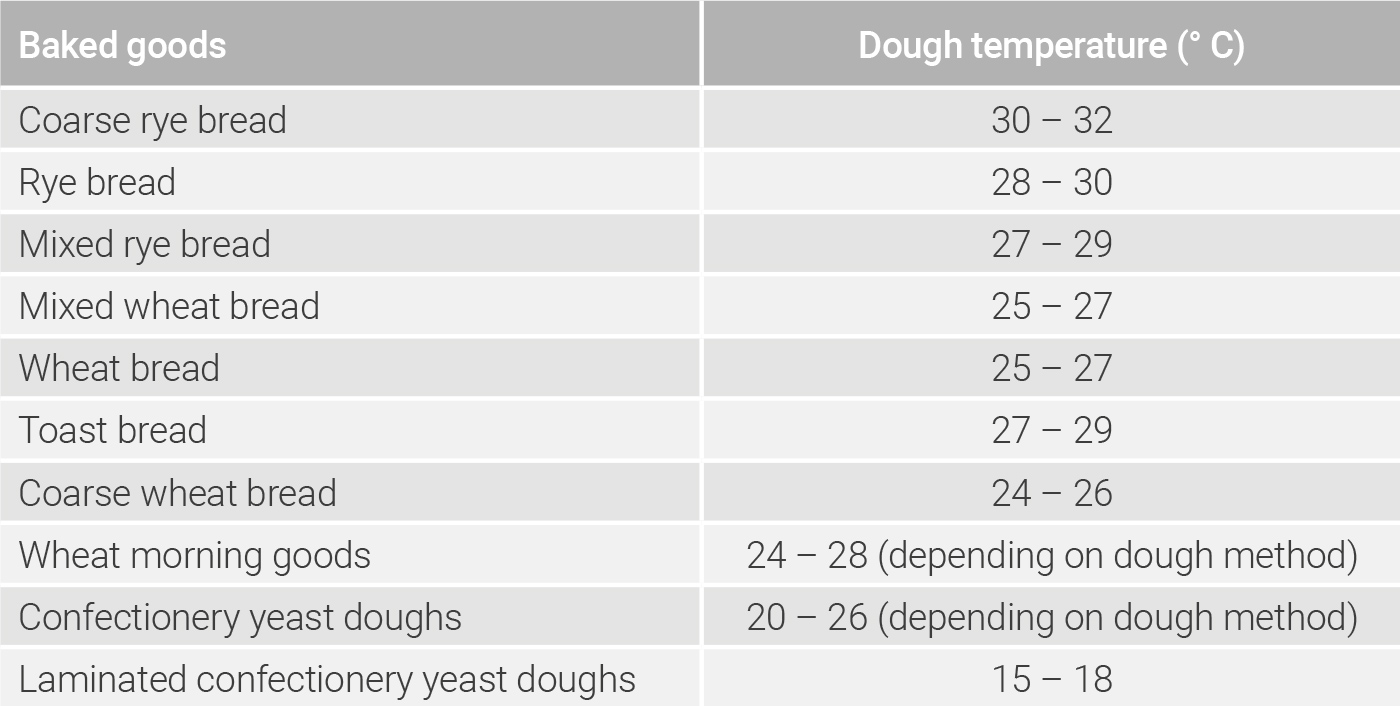
Average optimum dough temperatures
| Baked goods | Dough temperature (° C) |
|---|---|
| Coarse rye bread | 30 – 32 |
| Rye bread | 28 – 30 |
| Mixed rye bread | 27 – 29 |
| Mixed wheat bread | 25 – 27 |
| Wheat bread | 25 – 27 |
| Toast bread | 27 – 29 |
| Coarse wheat bread | 24 – 26 |
| Wheat morning goods | 24 – 28 (depending on dough method) |
| Confectionery yeast doughs | 20 – 26 (depending on dough method) |
| Laminated confectionery yeast doughs | 15 – 18 |
Effects of non-optimal dough temperatures
Good machinability and dry and woolly doughs have a close connection to the dough temperature. Too cold or too warm doughs are difficult to process and are frequently followed by baked goods faults. In the table below, the influence on the baked goods quality is shown.
Effects of the dough temperature on the dough behaviour and the quality of the baked goods
| Dough temperature | Effects |
|---|---|
| Too cold doughs | • long final proof time • low aeration • little aromatic taste • narrow crust crack |
| Too warm doughs | • more rapid final proof • less swelling time • stronger degradation of the dough texture • poorer gas retention property • too irregular crumb texture • dull upper surface • wide crust crack |